


04/09/26
What Is a Mortice Knob? A Guide to Mortice Door Knobs
Mortice knobs are a traditional style of round door knob most commonly associated with rim locks, but they can also be used with tubular latches and, in some circumstances, mortice locks.
The name can be a little confusing. A mortice knob is the knob you turn; it does not mean that you automatically need a mortice lock.
Every week we help customers work out which latch, lock and other components they need with their mortice knobs, particularly when restoring older doors or replacing existing hardware.
This guide explains the different ways mortice knobs can be used, the difference between Passage, Privacy and Dummy functions, and the important measurements to check before ordering.
You can also browse our full Mortice/Rim Lock Door Knob range to see the different styles and finishes available.
Quick guide: what can mortice knobs be used with?
| Setup | How it works |
|---|---|
| Passage door | The knobs operate a tubular latch so the door can latch closed without locking |
| Privacy door | The knobs operate the normal latch, while a separate privacy turn operates the privacy locking mechanism (privacy bolt) |
| Rim lock | One backplate is removed so the knob can sit directly against the surface mounted rim lock |
| Mortice lock | Both backplates remain fitted and the threaded spindle operates a compatible mortice lock recessed into the door |
| Dummy application | The knob is fixed in place to the face of the door and does not operate a latch or lock |
What comes with a mortice knob set?
Standard operating mortice knob pairs are usually supplied with the components that make up the knob set itself, including:
• two knobs
• two detachable backplates
• a threaded spindle
• fixing screws
You do not need to purchase the spindle or backplates separately.
The detachable backplates are particularly important when using the knobs with a traditional rim lock. One backplate can be removed so the knob sits directly against the rim lock body, while the second remains fitted on the opposite side of the door.
Exact inclusions can differ between Passage, Privacy and Dummy versions, so always check the individual product listing or contact us for more information.
The important thing is to first work out what you need the door to do and then choose the appropriate latch or lock, if required.
Passage, Privacy or Dummy: which function do I need?
Before choosing the latch or lock, work out what you need the door to do.
Passage mortice knobs
A Passage Set is used where the door needs to open, close and latch, but does not need to lock.
Typical applications include living rooms, hallways, laundries and other internal rooms.
If there is no rim lock already fitted, a Passage mortice knob would normally be used with a tubular latch.
Privacy mortice knobs
Our mortice knob ranges are also available in a Privacy function for bathroom and toilet doors.
With the mortice knobs we sell, the privacy turn is separate from the knob. The locking function is not incorporated into the mortice knob itself.
The knob continues to operate the normal tubular latch used to open and close the door. A separate privacy turn, positioned above or below the knob, operates the privacy locking mechanism.
A typical Privacy setup therefore requires:
• the Privacy mortice knob set
• a tubular latch for everyday opening and closing
• a compatible privacy bolt locking mechanism
Our current mortice knob range specifies that Privacy versions are supplied with a separate privacy turn and require both a privacy mechanism and tubular latch.
Check the individual product listing to confirm exactly what is included with the selected Privacy option or contact us for further information.
We have included a helpful diagram below and you can also browse our range of privacy locks, bolts and related hardware.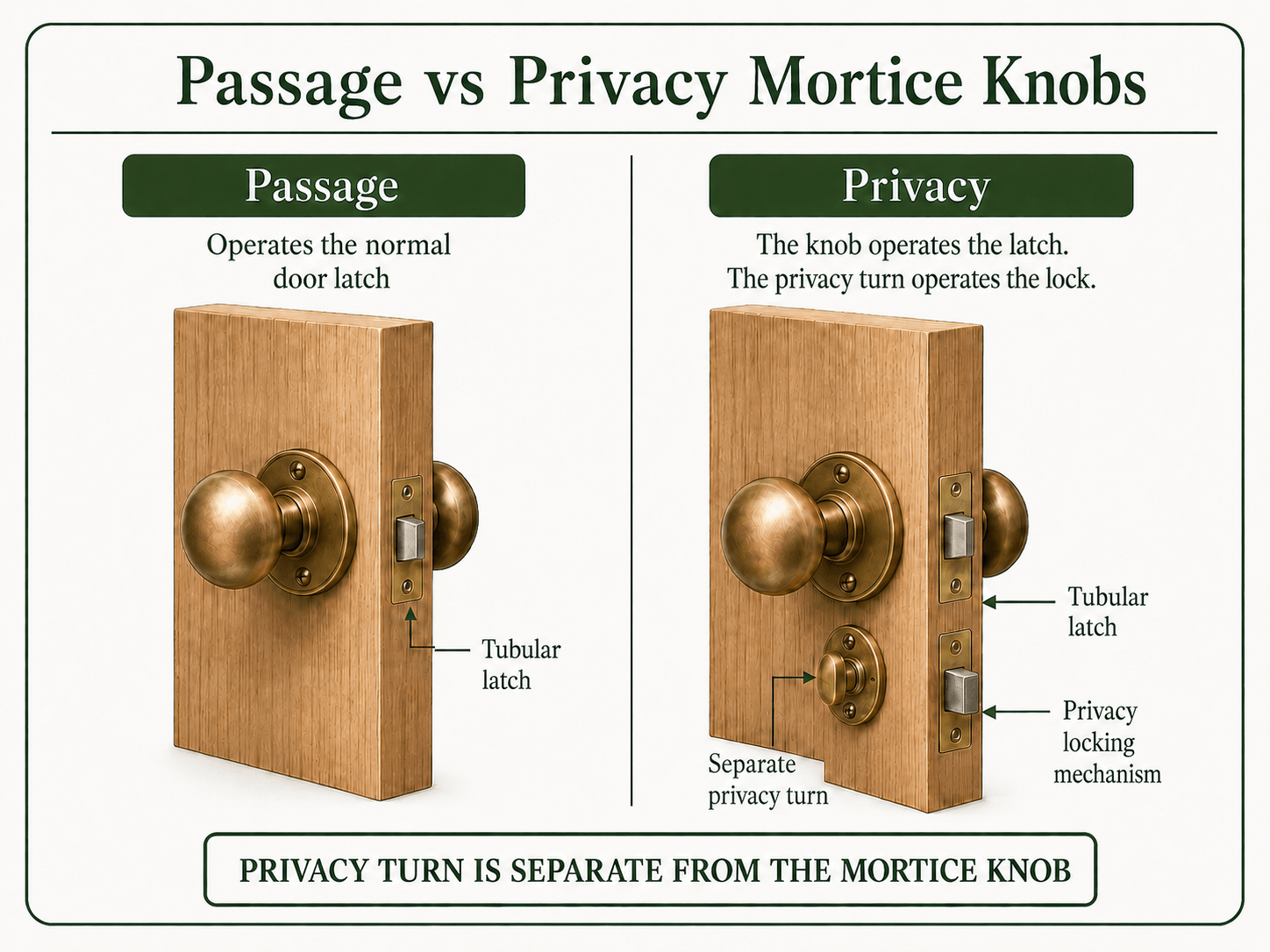
Figure 1. Passage mortice knobs operate a standard door latch. With a Privacy setup, the knob still operates a standard latch while a separate privacy turn operates the locking mechanism (privacy bolt).
Dummy mortice knobs
A Dummy knob is fixed in place and does not operate a latch or lock. They are fixed to the face of the door using a part called a Taylors Spindle.
Unlike standard spindles that pass through the door to connect the handles, it is fixed to the face of the door. The knobs are then threaded onto the Taylors spindle and the backplate is secured using the supplied screws, and the knobs are secured onto the spindle using grub screws.
Dummy knobs can be useful for wardrobes, cupboards, doors held closed by another mechanism, or the inactive leaf of some double French doors.
Some Dummy options are supplied as one knob and others as a pair, so check the individual product listing before ordering.
Using mortice knobs with a rim lock
A rim lock is the traditional pairing for this style of mortice knob.
A rim lock sits on the surface of the door, rather than being recessed into the door edge.
When compatible mortice knobs are fitted to a rim lock, one of the supplied backplates is removed. The knob sits directly against the rim lock body, while the threaded spindle passes through the lock and door to the second knob.
The second backplate remains fitted on the opposite side of the door. This detachable backplate and threaded spindle are specifically what allows these knobs to work with traditional rim locks.
You will generally need:
• your mortice knob set
• a compatible rim lock
• an escutcheon for the keyhole on the opposite side if the rim lock does not already include one
If you are new to traditional rim locks, our What Is a Rim Lock? guide explains how they work in more detail.
You can also browse our full rim lock range.
Some rim locks include the matching escutcheon and others require one to be ordered separately.
See below diagram below how a mortice knob works with a rim lock.
Figure 2. When mortice knobs are used with a rim lock, one supplied backplate is removed so the knob can sit directly against the rim lock body. The second knob retains its backplate on the opposite side of the door, and an escutcheon is used on this side of the door also.
Using mortice knobs with a tubular latch
Mortice knobs can also be installed on a standard internal door without a rim lock.
In this setup, both supplied backplates remain fitted. The threaded spindle passes through a tubular latch installed into the edge of the door.
Turning either knob rotates the spindle and retracts the latch.
You will generally need:
• your mortice knob set
• a compatible tubular latch
You can browse our Tubular Latches or read our guide to Choosing Latches for Passage Door Knobs.
For mortice knobs, we recommend a 60mm backset wherever possible. There is an important practical reason for this, which we cover further below.
Can you use a mortice knob with a mortice lock?
Yes. A mortice knob can be used with a compatible mortice lock.
However, we do not offer a mortice lock as a standard selectable lock option with mortice knobs on our website.
This is not because the combination cannot be used. The main consideration is the relationship between the mortice lock body inside the door and the face fixed backplates on the knobs.
A mortice lock has a relatively large lock body recessed into the edge of the door. The two supplied mortice knob backplates are then fixed to the faces of the door using screws.
On a thinner door, the lock body can leave very little timber for those screws. The screws may run into the lock case rather than fixing properly into the timber.
For this reason, we generally recommend using mortice knobs with a mortice lock on a door that is approximately 45mm thick or greater.
Even with a 45mm door, the backplate screws may sometimes need to be shortened so that they do not contact the mortice lock body.
If the screws need shortening, will the knobs still be secure?
Yes.
This is where the construction of a traditional mortice knob is important.
The supplied threaded spindle passes through the mortice lock, and the knobs thread onto it from either side of the door. The knobs are then also secured to the spindle using the included grub screws.
Therefore the knobs do not rely solely on the backplate screws to hold them onto the door.
The backplate screws secure and stabilise the backplates against the door face, while the threaded spindle and grub screws connect and secure the two knobs.
This means that if the screws need to be shortened to avoid the mortice lock body, the mortice knob setup can still work.
So if you:
• already have mortice knobs operating a mortice lock
• are replacing an existing mortice knob and mortice lock setup
• or specifically want to use a mortice lock
there is no need to rule the arrangement out.
We simply recommend checking the door thickness first and generally suggest 45mm or thicker for face fixed mortice knobs.
The knob set already includes the two backplates, threaded spindle and screws. You would additionally need the compatible mortice lock and the appropriate skeleton key escutcheon/s.
Do I need an escutcheon?
An escutcheon is the small plate fitted around a traditional keyhole.
Whether you need one depends on the type of lock.
With a tubular latch
No escutcheon is required because there is no keyhole.
With a rim lock
The visible rim lock body provides the keyhole on the side where the lock is mounted.
On the opposite side of the door, the key passes through the timber. An escutcheon is normally fitted around this opening to protect the door and provide a neat finish.
Some rim locks include the escutcheon and others do not.
With a mortice lock
A mortice lock is hidden inside the door, so the keyhole passes through the face of the door.
Depending on the lock and installation, you may require an escutcheon around the keyhole on each side where the key is accessed.
You can browse our escutcheons to find a suitable style and finish.
Escutcheons are an easy part to overlook, so we recommend checking if you need them, and they come included when you choose the knobs and lock.
What is the difference between a rim lock, tubular latch and mortice lock?
These terms are easy to confuse because all three can be used as part of a door knob setup, but they sit in different positions.
| Mechanism | Where it sits | What it does |
|---|---|---|
| Rim lock | Mounted on the face of the door | Provides traditional latching and, on keyed models, locking |
| Tubular latch | Small mechanism installed into the door edge | Holds the door closed but does not provide keyed locking |
| Mortice lock | Larger lock body recessed into the door edge | Provides both a latch and traditional locking function |
The mortice knob is the handle that operates the mechanism.
This is why the word mortice in mortice knob does not mean that you have to install a mortice lock.
What backset should I use with a mortice knob?
For round mortice knobs, we recommend a 60mm backset wherever possible.
Backset is the distance from the edge of the door to the centre of the spindle.
With a round knob, your hand wraps around the knob as you turn it. The shorter the backset, the closer the knob sits to the edge of the door and therefore to the door frame.
If the knob is too close to the frame, there may be very little room for your hand and it is easy to scrape your fingers or knuckles against the door jamb.
For this reason, we generally do not recommend using a backset smaller than approximately 60mm with mortice knobs when the 60mm option will comfortably fit the door.
Our existing Passage Door Knob latch guide gives the same advice: although 45mm latches will work with knobs, the reduced clearance can make them awkward to use.
If you're unsure how the backset is measured, our Measuring Your Backset guide includes diagrams and examples.
Can I use a 45mm backset?
Yes, if the door requires it.
A shorter 44–46mm backset may be necessary on:
• narrow stile doors
• glazed doors
• some panelled doors
• French or double doors
• existing doors where the latch or lock position has already been established
It can be used, but the knob will sit closer to the edge of the door and there will be less clearance for your hand.
Where both options comfortably fit, we recommend the 60mm backset for a mortice knob.
What if my door has glass, panels or a narrow stile?
The stile is the vertical section of timber where the knob, latch or lock is installed.
On glazed or panelled doors, there may be limited timber available, so a 60mm backset will not always fit.
Before ordering, check the available stile width, the position of any glass or panels, the required backset and the size of the knob and backplate.
Do not automatically choose the shortest backset simply because the door has panels or glass. Where possible, use the longest suitable backset that fits comfortably within the available timber.
Our Measuring Your Backset guide explains how to check this.
Can mortice knobs be used on French doors?
Yes, but French and double doors need a little more planning.
You need to consider whether the inactive door needs a Dummy knob, the available stile width, the backset and whether the doors are rebated.
There may also be additional hardware such as flush or surface bolts used to secure the inactive door.
Our French Door Handles & Hardware: A Simple Guide explains active and inactive doors, rebates, dummy handles and the other hardware commonly required.
Will a mortice knob cover the existing hole in my door?
Not necessarily.
Traditional mortice knobs generally have relatively small, face fixed backplates.
If you are replacing a modern handle installed with a larger hole, the new mortice knob backplate may not cover it.
Some retro-fit mortice knobs have larger backplates specifically designed for this situation, including options designed to cover a standard 54mm bore hole.
Before ordering, measure:
• the existing hole
• the new backplate diameter
• the existing backset
• any visible fixing holes
Our Replacing Existing Handles guide also covers the main measurements to check when changing existing door furniture.
Can I reuse my existing rim lock, latch or mortice lock?
Often, yes.
This is particularly common in heritage renovations where an older lock is still working and only the knobs need replacing.
Before ordering, check that the existing mechanism operates correctly and, where possible, confirm its spindle size, backset and door thickness.
Older locks and spindles are not always universal, so compatibility should be checked rather than assumed.
If you're unsure, send us clear photos of both sides of the door, the edge of the door and the existing lock or latch, together with any measurements you can take. We help customers work through these setups regularly, and photos can make it much easier to identify what you already have.
Common mistakes when choosing mortice knobs
Assuming a mortice knob needs a mortice lock
It doesn't. Rim locks and tubular latches are the most common applications for these knobs.
Selecting Passage when the door needs Privacy
If the door is a bathroom or toilet, check the Privacy option. On our mortice knobs, the privacy turn is separate from the knob.
Forgetting the latch
If you are installing mortice knobs on a standard Passage door without a rim lock, you still need a tubular latch.
Forgetting the escutcheon
A keyed rim lock may need an escutcheon on the opposite face. A keyed mortice lock may require escutcheons around the keyhole on both sides of the door.
Choosing too short a backset
For mortice knobs, we recommend around 60mm wherever possible to provide better clearance between your hand and the door frame.
Using a mortice lock without considering door thickness
The combination can work, but for these face fixed knobs we generally recommend a door around 45mm thick or greater.
Assuming the new backplate will cover existing holes
Measure first. A retro-fit mortice knob may be a better option if the existing handle hole is larger than the new backplate.
Mortice Knob FAQs
Do mortice knobs need a mortice lock?
No. A mortice knob can operate a rim lock, tubular latch or compatible mortice lock.
What are mortice knobs traditionally used with?
These mortice knobs are particularly well suited to rim locks because one of the detachable backplates can be removed so the knob sits directly against the rim lock body.
Do mortice knobs come in Privacy?
Yes. Many of our mortice knob ranges are available in Passage, Privacy and Dummy functions. With our Privacy mortice knobs, the privacy turn is separate from the knob.
Can mortice knobs be used on a normal internal door?
Yes. Both backplates remain fitted and the knobs can operate a compatible tubular latch.
Can I use mortice knobs with a mortice lock?
Yes. We generally recommend a door approximately 45mm thick or greater because the mortice lock body sits inside the door while the knob backplates are face fixed.
Why don't you offer a mortice lock as a standard option online?
A rim lock or tubular latch is a more straightforward setup for these particular knobs. A mortice lock can still be used, but the door needs enough thickness for the face fixed backplates to be installed alongside the recessed lock body.
If the backplate screws need shortening, will the knobs still be secure?
Yes, to a certain extent. The knobs thread onto the supplied threaded spindle through the door, so they do not rely solely on the backplate screws to connect the two knobs.
What backset do you recommend for mortice knobs?
We recommend approximately 60mm wherever possible. A shorter backset places your hand closer to the door frame and can lead to scraped knuckles.
Can I use a 45mm backset?
Yes, if required by the construction of the door. If 60mm comfortably fits, that is our preferred option for a round mortice knob.
Do I need an escutcheon?
It depends on the lock. A keyed rim lock may require one on the reverse side of the door, while a keyed mortice lock may use escutcheons around the keyhole on each side of the door.
Can I reuse my existing lock?
Often, provided it is working and the spindle and other measurements are compatible. Photos and measurements can help us check an existing setup.
What should I check before ordering mortice knobs?
Before ordering, work through these points:
• Function: Passage, Privacy or Dummy?
• Mechanism: Rim lock, tubular latch or mortice lock?
• Backset: Around 60mm is our preference for round mortice knobs wherever possible.
• Door thickness: If using a mortice lock, we recommend approximately 45mm or greater.
• Stile width: Particularly important on glazed, panelled and French doors.
• Existing holes: Will the new backplate cover them?
• Escutcheons: Are they needed, and are they included with your chosen lock?
• Existing hardware: Are you retaining an existing latch or lock?
• French doors: Which leaf is active, and are the doors rebated?
If you're still unsure, we're happy to help. Photos of both sides of the door, the door edge and any existing lock or latch, together with a few measurements, are usually enough for us to point you in the right direction.
You can browse our Mortice/Rim Lock Door Knobs, Rim Locks, Mortice Locks, Tubular Latches and Escutcheons, or use our Measuring Your Backset guide before ordering. See below links to the relevant pages.


